How to write a press release with ChatGPT or other AI without it sounding like AI
An AI assistant can save you from the blank page. But a press release is the official version of your company's news: every sentence has to be true and checkable. AI helps with the form; the substance comes from you.

What is AI good at when writing a press release?
AI is good at the form of a press release: structure, length and clean sentences.
- Ordering the facts into the classic structure: headline, first paragraph, body, quote and boilerplate.
- Suggesting several headlines for you to choose from.
- Shortening long sentences and removing jargon.
- Spotting repetition and grammar mistakes.
- Adapting a finished release to another language or audience, for you to review.
The structure it should follow is in the parts of a press release.
What should you never leave to AI in a press release?
Never leave the facts, the quotes or the names to AI: those are what it gets wrong in a convincing way.
| Part | Risk | What to do |
|---|---|---|
| Figures and dates | AI fills gaps with plausible but false numbers | Give them yourself and check them in the final text |
| Quotes | An invented quote is a statement nobody made | Have the person who gives it write it, or mark it as a gap |
| Names and job titles | It changes names, titles or companies | Check them one by one |
| Leadership claims | It adds “leading”, “first”, “revolutionary” | Delete them if you cannot prove them |
| Third-party data | It attributes studies or figures to sources that never said them | Only cite sources you have read |
A release with an invented figure is not just a mistake: it is the source others will copy. Check every figure before you publish.
How do you ask ChatGPT to write a press release?
Give ChatGPT a list of facts, the structure you want and an explicit ban on inventing anything, then check the draft.
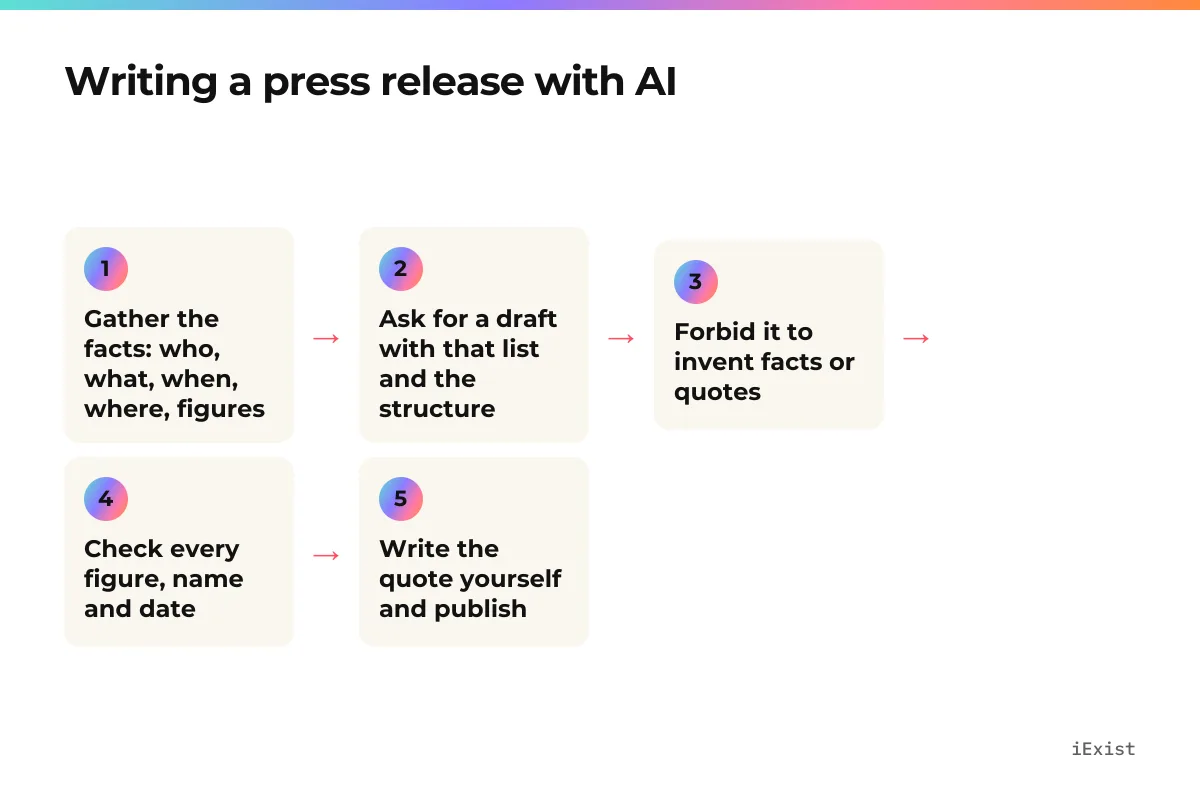
- Write a list of facts first: who, what, when, where, why it matters, and the exact figures.
- Give it to the assistant and ask for a press release with a headline, first paragraph, body, a gap for the quote and your company boilerplate.
- Tell it explicitly not to add any facts, figures, names or quotes that are not on the list, and to mark the gaps.
- Ask for two or three alternative headlines and choose the one that states the news plainly; see how to write a press release headline.
- Check the text against the common press release mistakes before you publish it.
An example prompt that works:
Write a press release in English using these facts and only these facts:
[list of facts]

Structure: headline, first paragraph (who, what, when, where), two or three paragraphs of context, a [QUOTE] gap for the statement, and the boilerplate:
[company boilerplate]

Do not invent figures, dates, names or quotes. If a fact is missing, write [MISSING: …]. No superlatives such as “leading” or “revolutionary”.
Example: a press release written with AI and checked
Nordlicht Bikes, a fictional bike shop in Hamburg, opens a repair workshop. Its founder gives an AI assistant the address, the opening date, the opening hours and the price of a basic service. The draft arrives in a minute, but it adds that this is “the most modern workshop in the city” and a quote from the founder that she never said.
She deletes the sentence, writes her own quote about what she really wants to say, and checks that the price and date match her list. The result reads as hers, and there is nothing in it a journalist could disprove.
Can you tell a press release was written by AI?
Often, yes: generic sentences, adjectives without facts, repeated structures and quotes that could come from any company. What gives it away is not the tool but the lack of concrete facts. A release with your own data, a real quote and checkable names reads as your company's, whether or not AI helped to order it.
AI assistants and Google value the same thing: true, specific information with a clear source. We explain it in how to get your news into AI assistants and what E-E-A-T is.
Questions
- Is it legal to publish a press release written with AI?
- Yes. What matters is that what it says is true and that your company stands behind it, just as if you had written it by hand.
- Do I have to say the press release was written by AI?
- There is no general rule requiring it for a press release, but the release must be accurate and the quote must come from the person it is attributed to. If you use AI, check that everything it says is true.
- Which AI is best for writing press releases?
- Any current assistant can produce a draft. The difference is not the tool but the facts you give it and the checking you do afterwards.
- Does iExist write the press release with AI?
- iExist can suggest a draft from the details you enter, without inventing figures, names or quotes: where a fact is missing it leaves a gap for you to fill. An editor reviews the company before it publishes.
Part of: How to get your news into ChatGPT, Gemini and other AI assistants with press releases