Press releases and SEO: what helps on Google and what does not
Press releases have a reputation as an SEO trick. What works is simpler: clear news, published where Google can read it, that others want to cite.

How a press release helps SEO
- Brand searches: when someone searches for your company or product, they find official, dated news.
- Searches for the news: if the release uses the words people use to describe what you did, it can appear in those searches.
- A source for others: journalists and bloggers have correct facts to cite, and when they cite you they may link to you.
- Signs the company exists: a newsroom with consistent news helps Google and AI assistants understand who you are.
Press releases and links: what Google says
Google's spam policies treat links with optimised anchor text in press releases distributed across other sites as link schemes, just like excessive link exchanges. A release written to place links does not help you and can harm both the site that publishes it and the site it links to.
That is why iExist does not sell links. Links in the text of a release are limited to a few and carry rel="nofollow": they are there for the reader. Your company's website is linked under each release, as a reference to who published it.
The links that count are editorial: a journalist reads the release, writes their own piece and links to you as a source because they want to. That comes from good news, not from more links in the text.
How to optimise a press release for SEO
The words in the headline and lead
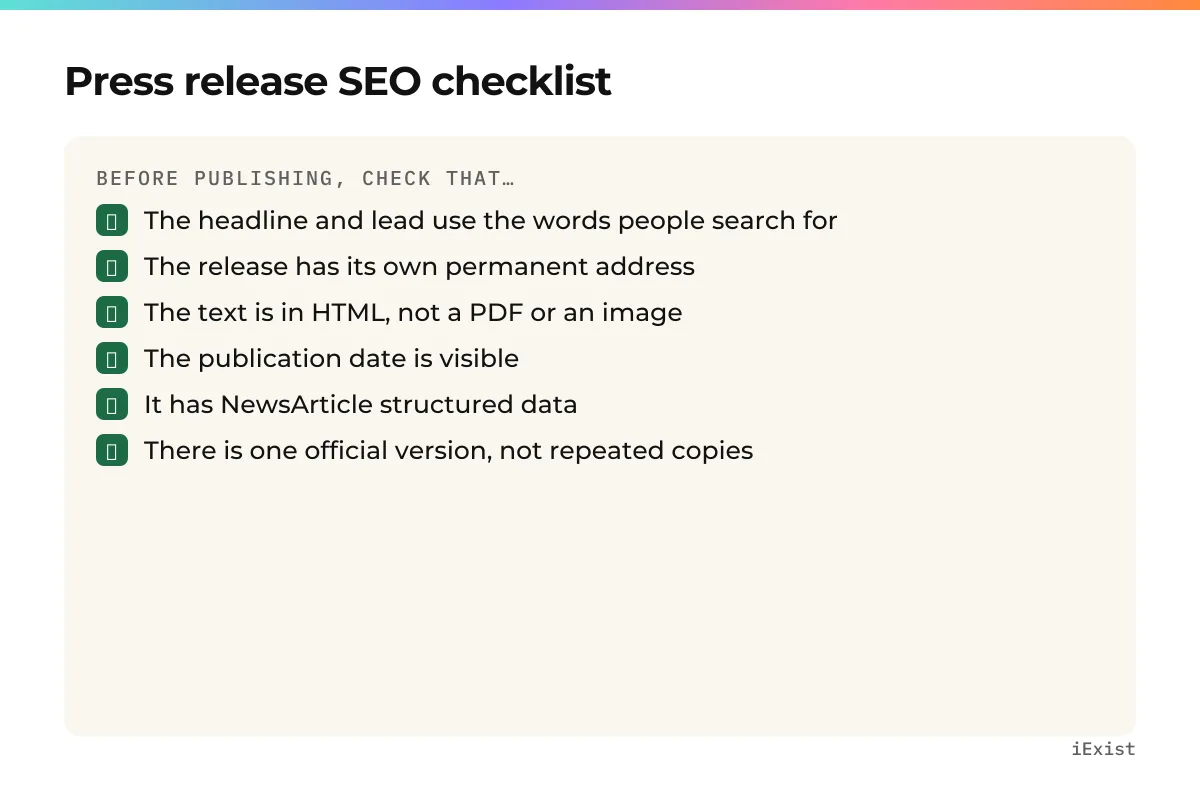
Use the words people type to describe what you did: “folding electric bike”, not “mobility solution”. Put them in the press release headline and the press release lead naturally. If you tell the news clearly, they are usually there without forcing them.
A page of its own for each press release
Each release at its own permanent, readable address, with the date visible and the text in HTML, not in a PDF or an image. If you change the address later, you lose the links and mentions that pointed to it.
Structured data and date
Structured data (schema.org NewsArticle) tells Google what the page is, who publishes it and when. On iExist every release has it, along with the date, the original language marked, and versions in six languages, each at its own address.
Original content, not repeated
The same release copied onto many sites adds nothing: Google picks one version and tends to ignore the rest. Keep one official version on your website and, if you publish on a platform, make sure it offers something your website does not, such as new readers or translations.
Example of a press release written with SEO in mind
| Element | Weak version | Clear version |
|---|---|---|
| Headline | Kiwi Coffee Roasters takes another step in its pursuit of excellence | Kiwi Coffee Roasters opens its second speciality café in Munich |
| Lead | An exciting new chapter | Address, opening date, opening hours and number of jobs |
| Links | Five links to the online shop with the text “speciality coffee Munich” | One link to the café's page, with its name |
| Format | Attached PDF | Its own page with a date and structured data |
Kiwi Coffee Roasters is a fictional company. The clear version is the same length; the only difference is that it says something concrete.
What not to expect from a press release in SEO
- That a single release will put you first for a competitive search.
- That links in the release will increase your authority.
- That publishing the same release on many sites will multiply the effect.
What a press release does for SEO depends on it working as news: someone finds it, reads it and cites it. The same goes for AI assistants, as we explain in how to appear in AI assistants. Over time, each release adds to your company's online authority. To get it to people who can cite it, see how to send a press release to the media.
Questions
- Are press releases good for getting backlinks?
- Not as such. Google treats links placed in releases distributed to rank as link schemes. Useful links come when an outlet covers the news and cites you of its own accord.
- Can a press release rank on Google?
- Yes, especially for searches for your brand and for the specific news, if it is on an indexable page with a permanent address and uses the words people search for. Review what a press release is if you are unsure what to announce.
- Is it duplicate content to publish my release on my website and on a platform?
- It will not penalise you, but Google will usually show only one version. Publish the official one on your website and use the platform to reach readers and journalists who do not know you.
- Does it help to publish the release in several languages?
- Yes, if each version has its own address and is marked correctly: people search in their own language and each version can appear in those searches.
Part of: What is a press release: definition, parts and purpose