Press release mistakes and how to avoid them
These are the slips that come up most often, ordered by the part of the release where they appear, with how to fix each one.

Why mistakes stop a press release from being published
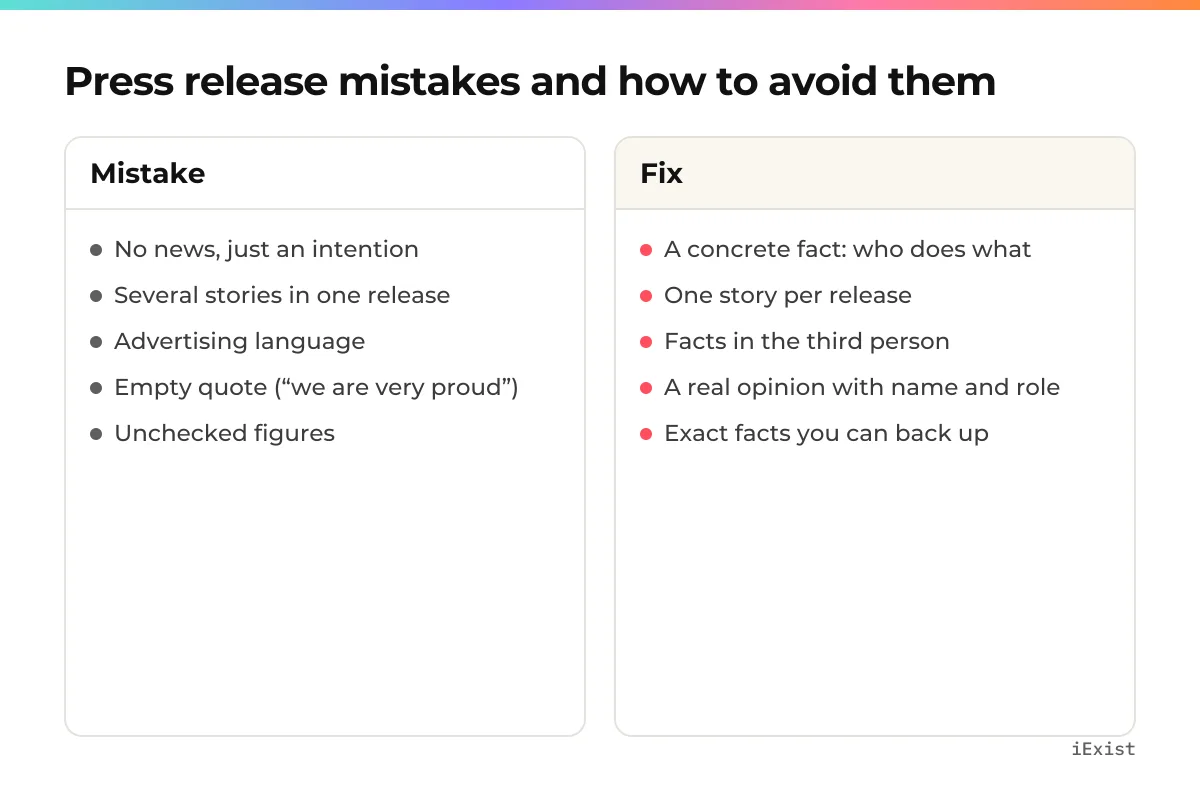
A journalist receives many releases and has little time for each one. If using yours means hunting for the news, checking doubtful figures or rewriting it into the third person, they usually will not bother. Almost every mistake on this list has that in common: it hands work to the reader.
If you are just starting, read how to write a press release first; this guide is for checking what you have already written.
Focus mistakes in a press release
Three focus mistakes can be spotted before you write a single line.
There is no news
“Lumen Bikes continues its commitment to sustainable mobility” is not news. “Lumen Bikes launches a 12 kg folding bike” is. Before you write, check you can say what is new in one sentence.
Several stories in one release
A launch, an appointment and an opening in the same text compete with each other. Choose one and keep the others for other releases. If you are not sure what kind of news you have, see the types of press releases.
Writing an advert
Offers, calls to buy and campaign language are not news. A press release reports a fact; an advert tries to sell.
Mistakes in the headline and lead
| Mistake | Example | Fix |
|---|---|---|
| Slogan headline | “A new era for coffee” | “Kiwi Coffee Roasters opens its second roastery in Munich” |
| Mood verb | “Harbor Health Labs is proud to announce…” | “Harbor Health Labs launches…” |
| Hidden news | A lead about the company's history | A lead with who, what, when, where and why |
| Two ideas in the headline | “…launches a product and appoints a director” | One idea; the other in another release |
There are formulas for each in how to write the headline and how to write the lead.
Writing mistakes in the body of a press release
- First person. “We have launched” forces a rewrite. Use the third person: “Lumen Bikes has launched”.
- Unproven superlatives. “Leading”, “revolutionary”, “the best”: journalists remove them. Replace them with a fact.
- Adjectives instead of figures. “Fast charging” says less than “charges in three hours”.
- Internal jargon. Project names, acronyms or technical terms with no explanation.
- Chronological order. Telling the story from the beginning instead of using the inverted pyramid: the important part at the top.
- Too long. Anything that does not help explain the news can go. See press release length and format.
Mistakes with quotes
The empty quote (“we are very proud of this milestone”) is the most repeated mistake. Next come quotes that repeat figures, quotes attributed to “a spokesperson” with no name, and quotes nobody has approved. A quote should give an opinion or a reason and carry a name and role. We explain it in how to write press release quotes.
Mistakes at the end: facts, company and contact
- The key facts are missing, or they are figures nobody could check.
- The “About the company” paragraph is the whole “About us” page, or it changes in every release. See press release boilerplate.
- There is no media contact, or it is a generic inbox nobody reads.
- Too many links in the text, which make it look like advertising.
Mistakes with facts and accuracy
These are the most serious, because they damage trust in all your future releases:
- Figures with no date or source.
- Names or job titles spelt wrong.
- Health, financial or performance claims you cannot back up.
- Invented quotes or facts.
On iExist an editor verifies each company before it publishes and reviews its releases until it is trusted, and may ask for changes. The publishing rules also limit the number of links in the text and reject duplicate releases.
Checklist to review a press release before sending it
- Can I state the news in one sentence?
- Does the headline have the company, an action verb and what happened?
- Does the lead make sense on its own?
- Is it in the third person outside the quotes?
- Is every figure correct and dated, and do I know where it comes from?
- Does the quote give an opinion, with a name and role?
- Are there key facts, an “About the company” paragraph and a contact who replies?
- Have I removed superlatives and jargon?
If you would rather not start from scratch, the press release template already has every part in place.
Questions
- What is the most common press release mistake?
- Not having clear news, or hiding it. If the lead does not say what happened, the rest of the release does not get read. See how to write the lead.
- Is it a mistake to send the release as a PDF?
- Usually: journalists prefer text they can copy. Best is a public page with the text and a link in the email; we explain it in how to send a press release.
- What is wrong with words like “leading” or “innovative”?
- They add no information and the journalist has to remove them. Replace them with the fact that would justify them.
- How do I know if my release has too much detail?
- If a paragraph can be removed without the reader losing anything they need to understand or report the news, it is not needed.