How to write quotes for a press release
The quote is the only part of the release written in a person's own voice. Used well, it gives the journalist something they cannot get from the facts. Used badly, it is the sentence everyone deletes.

What a quote in a press release is for
The rest of the release tells facts in the third person. The quote adds what facts do not say: why the company did it, what problem it sees, what it hopes will change. It is the part a journalist can reproduce in quotation marks in their own piece.
That is why a quote should not repeat figures already given in the lead or the body. If it can be removed without losing any information or opinion, it is not needed.
Who should speak in press release quotes
| Who | When it makes sense | What it adds |
|---|---|---|
| Founder or CEO | Launches, funding rounds, openings | The reason for the decision |
| Head of the relevant area | Appointments, technical products | Detail and expert judgement |
| Customer | Launches, use cases | How things change for the person using it |
| Partner or investor | Partnerships, funding | Why the other side is joining in |
| The person appointed | Appointments | What they want to do in the role |
One voice from the company is usually enough. Two quotes from two executives saying the same thing weaken the release. If you add a second one, make it someone from outside: a customer, a partner or an expert.
How to write a quote for a press release
A useful quote meets four conditions.
It is real and approved
The person said it or approved it in writing before publication. Never invent a quote or put it in the mouth of someone who has not seen it: it is the fastest way to lose a media outlet's trust.
It gives an opinion, not a fact
“The Lumen Fold weighs 12 kg” is a fact and belongs in the body. “People who combine the train and a bike do not need a bike for the whole journey, only for the last few kilometres” is a point of view, and that is a quote.
It sounds like a person
Write it the way that person speaks. If nobody would say the sentence out loud (“we are delighted to announce this strategic partnership, which strengthens our commitment”), rewrite it.
It is short
One or two sentences. If it is longer, split it or cut half.
Where the quote goes and how to attribute it
It usually goes in the third or fourth paragraph, after the lead and the main facts, following the inverted pyramid explained in how to write a press release. Never in the lead.
The attribution gives first name, surname, role and company the first time, with a neutral verb: “said”, “explained”, “added”. Avoid verbs that judge, such as “celebrated” or “proudly stressed”.
“[A sentence with an opinion or a reason, the way that person would say it],” said [First name Surname], [role] at [Company]. “[Optional second sentence].”
Examples of press release quotes
| Weak | Useful |
|---|---|
| “We are very proud of this milestone, which shows our leadership,” said the CEO of Harbor Health Labs. | “Many people stop checking their cholesterol because getting an appointment takes weeks. We want them to be able to do it at home and take the result to their doctor,” said Marta Reis, CEO of Harbor Health Labs. |
| “This agreement is great news for both companies,” said a spokesperson. | “Our customers wanted speciality coffee in the morning and we had nowhere to roast it,” explained Jonas Weber, founder of Kiwi Coffee Roasters. |
The useful quotes give a reason and have a name attached. The people and companies in the examples are fictional.
Common mistakes with press release quotes
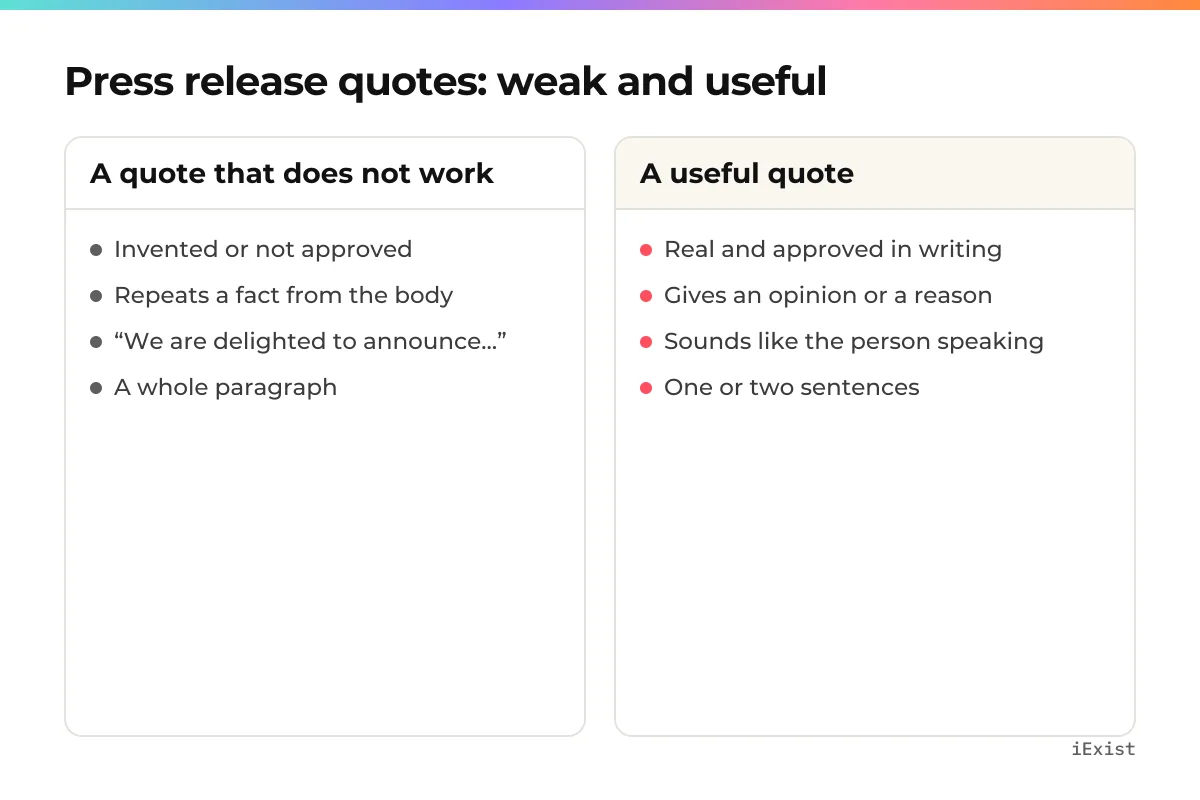
- Quotes that repeat the lead inside quotation marks.
- Superlatives you could not write outside quotation marks (“the best product on the market”).
- Attributing to “a spokesperson” with no name.
- Three or more quotes that say the same thing.
- Quotes nobody has approved.
Go through the other usual slips in common press release mistakes. If you name someone in the quote, check that their role matches the one in the press release boilerplate and the contact.
Questions
- How many quotes should a press release have?
- One or two. One from the company and, if it adds something, another from someone outside. More quotes tend to repeat the same idea.
- Can the journalist change the quote?
- They can shorten it or use only part of it, but should not change its meaning. That is why each sentence of the quote should stand on its own.
- Can I use a customer quote?
- Yes, if the customer has approved it and agrees to appear by name. It is often the quote the media find most interesting in a product launch.
- Is the quote in the first person?
- Yes. It is the only place in the release where the first person is used; the rest is written in the third person, as we explain in how to write a press release.